
Fast Growing Privacy Hedge Plants: 9 Best Picks for Florida & the Southeast

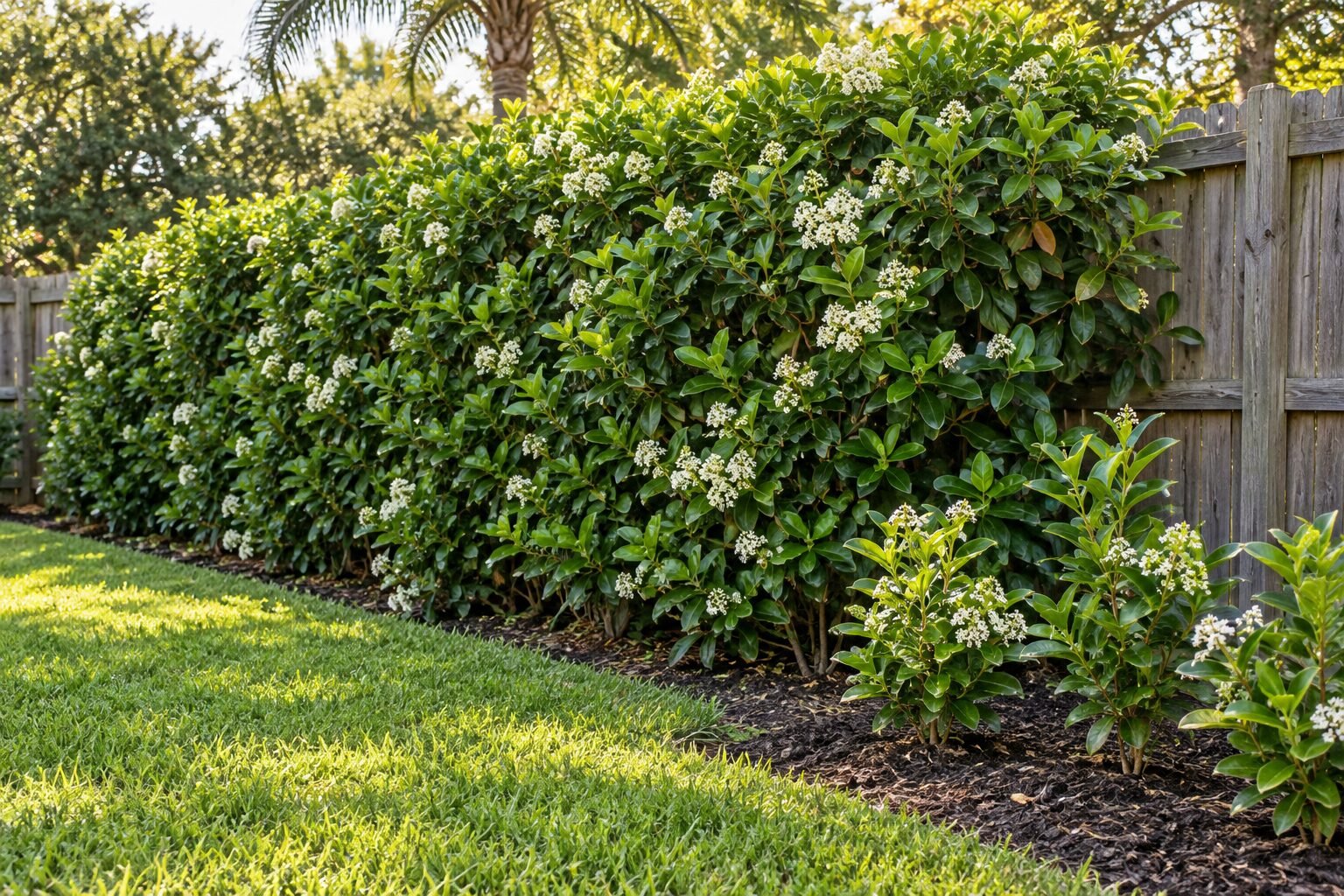
If you need a fast growing privacy hedge, the plant you pick matters more than anything else you do. Some shrubs close a gap in two or three seasons, while others stay thin for years. Below we compare nine hedge plants we grow here in Jacksonville, with honest growth rates, mature sizes, spacing, and a simple way to work out how many plants to order.
Quick answer: for most of Florida and the warm Southeast, sweet viburnum and wax myrtle are the fastest dependable evergreen screens. Red tip photinia and bottlebrush come next, while podocarpus grows slower but gives the neatest formal wall.
- Fastest native option: wax myrtle, about 3 to 5 feet of growth per year in good conditions.
- Best all-around screen: sweet viburnum, easy to keep at 6 to 8 feet with a few trims a year.
- Typical spacing: 3 to 5 feet apart on center for a solid row, closer for a quicker fill.
How We Ranked Each Fast Growing Privacy Hedge Plant
Speed alone, however, does not make a good hedge. A plant that shoots up but drops its lower leaves, or that struggles with disease in humid summers, will leave you with gaps. So we looked at how quickly each plant thickens, its mature size, how it handles Florida heat and humidity, and how much trimming it needs.
We also flag the downsides, because two of these plants are invasive in Florida and one struggles in our humidity.
Comparison Table: Growth Rate, Size and Spacing
| Plant | Growth rate | Hedge height | Spacing | USDA zones |
|---|---|---|---|---|
| Sweet viburnum | Fast | 6 to 12 ft | 3 to 4 ft | 8 to 10 |
| Wax myrtle | Very fast | 8 to 15 ft | 4 to 6 ft | 7 to 11 |
| Red tip photinia | Fast | 6 to 12 ft | 4 to 5 ft | 7 to 9 |
| Red Cluster bottlebrush | Moderate to fast | 6 to 10 ft | 4 to 5 ft | 8 to 11 |
| Podocarpus | Slow | 4 to 12 ft | 2 to 3 ft | 7 to 11 |
| Italian cypress | Moderate | Tall and narrow | 3 to 4 ft | 7 to 10 |
| Viburnum Spring Bouquet | Moderate | 4 to 6 ft | 3 to 4 ft | 7 to 10 |
| Glossy privet (Ligustrum lucidum) | Fast | 8 to 10 ft | 4 to 6 ft | 8 to 10 |
| Variegated Chinese privet | Fast | 6 to 10 ft | 3 to 4 ft | 7 to 10 |
Hedge heights assume regular trimming, because several of these plants become small trees if left alone. Also check your zone: sweet viburnum and bottlebrush need zone 8 or warmer, while photinia prefers zone 9 or cooler. You can browse by climate on our zone 9 plant page.
The 9 Best Fast Growing Privacy Hedge Plants
1. Sweet Viburnum: Best All-Around Privacy Hedge Plant
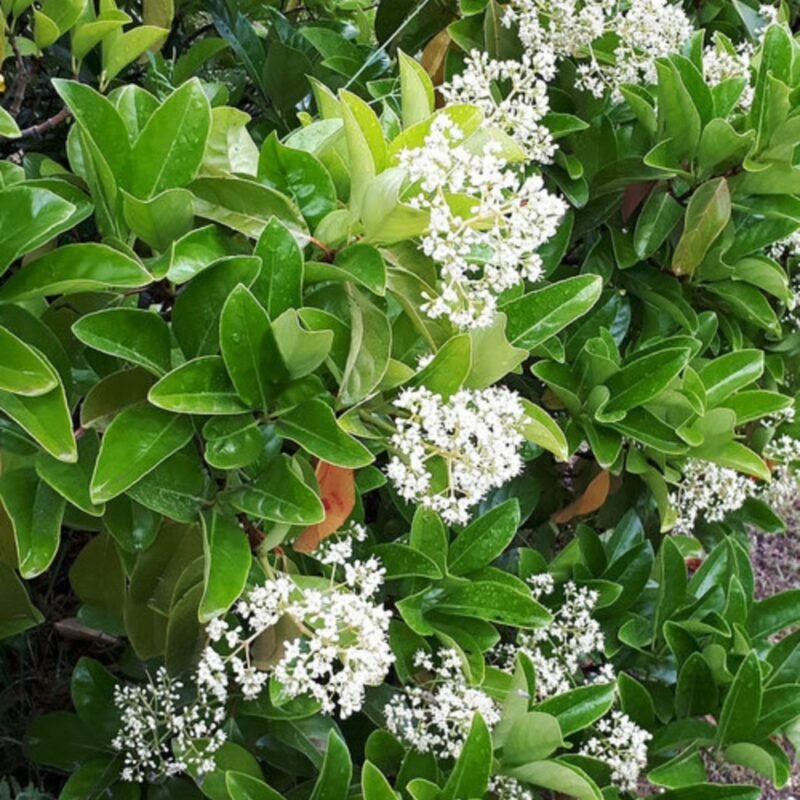
Sweet viburnum (Viburnum odoratissimum) is the hedge you see around so many Florida homes, and for good reason. It also has large, glossy leaves, fragrant white flowers in spring and red berries that turn black for the birds. Left untrimmed it can reach 20 to 30 feet, yet it shears easily into a 6 to 8 foot wall. For a fast growing privacy hedge in zones 8 to 10, it is hard to beat.
It grows best in full sun to part shade, and it tolerates drought once established. However, it does not like salt spray, so skip it on oceanfront lots. It is hardy in zones 8 to 10, and the berries are mildly toxic if eaten.
2. Wax Myrtle: Fastest Native Choice
Wax myrtle (Myrica cerifera) is a Florida native and one of the quickest shrubs you can plant, often adding 3 to 5 feet a year. It also handles wet soil, dry sand and salt spray, which makes it a top choice for coastal yards. Its berries also feed birds.
The trade-off, however, is upkeep. According to UF/IFAS Extension, wax myrtle sends up root sprouts that need removing a few times a year, and the branches can break in storms. Also, give it room, because untrimmed plants spread 20 feet or more. Even so, it is the most forgiving fast growing privacy hedge for tough sites.
3. Red Tip Photinia: Most Colorful Quick Screen
Red tip photinia (Photinia x fraseri) flushes bright red new growth every spring and after each trim. Because it fills in quickly, it shears into a dense hedge at almost any height. As a result, it remains a favorite for people who want color along with screening.
The honest drawback, though, is Entomosporium leaf spot, which is common on photinia during wet, humid weather in Florida. To lower the risk, plant in full sun, space the plants 4 to 5 feet apart for airflow, and water at the soil rather than over the leaves. Since it is hardy in zones 7 to 9, it suits North Florida best.
4. Red Cluster Bottlebrush: A Flowering Option for Pollinators
Red Cluster bottlebrush (Callistemon citrinus) brings cherry-red blooms from late spring through summer, and hummingbirds love them. It is also drought tolerant, handles moderate salt and grows into a dense evergreen screen in full sun. However, the 2025 UF/IFAS Assessment now rates red bottlebrush (Callistemon citrinus) as a high invasion risk that it does not recommend anywhere in Florida, so Florida gardeners should consider a native such as wax myrtle instead.
Because it is looser and more informal, it works best as a natural screen. It is hardy in zones 8 to 11, so it shines in Central and South Florida and in warmer parts of North Florida.
5. Podocarpus: Slow but the Neatest Formal Wall
Podocarpus macrophyllus, also called yew pine, is not a fast grower, and we want to be clear about that. However, its narrow, upright habit and soft, dense foliage make the cleanest formal hedge of any plant here. It is also salt tolerant, deer resistant and hardy in zones 7 to 11.
Plant podocarpus closer, about 2 to 3 feet apart, to make up for the slower growth. In addition, keep children and pets away from the seeds, which are poisonous if eaten. If you can wait a few extra seasons, it rewards you with a hedge that needs very little fuss.
6. Italian Cypress: Tall, Narrow Screening With Caveats
Italian cypress (Cupressus sempervirens) forms a tall column only 3 to 6 feet wide, so it screens a two-story view without eating up your yard. It is also drought and heat tolerant and looks striking along a driveway or property line.
That said, UF/IFAS notes that mites are often a problem and root rot can set in on poorly drained soil. In humid Florida summers, it needs full sun, sandy well-drained soil and good airflow. So we suggest it for dry, sunny spots, not wet or shady ones.
7. Viburnum Spring Bouquet: Best for a Smaller Hedge
Viburnum Spring Bouquet (Viburnum tinus) is a compact evergreen that opens pink buds into white flowers in late winter and early spring. So it suits shorter hedges and borders where a 20-foot shrub would be too much.
Its growth is moderate rather than fast, so plant it 3 to 4 feet apart. Then trim lightly after bloom.
8 and 9. Glossy Privet and Variegated Chinese Privet: Fast, but Check Your State
Glossy privet (Ligustrum lucidum) and variegated Chinese privet (Ligustrum sinense) are both fast, tough and easy to shear. However, both are listed as Category I invasive plants in Florida, and the UF/IFAS Center for Aquatic and Invasive Plants documents how they spread into natural areas through bird-eaten berries.
For that reason, we do not recommend either privet for Florida gardens. Instead, choose wax myrtle or sweet viburnum, since either one makes a fast growing privacy hedge without the invasive risk. Outside Florida, check your state’s invasive list first. The leaves and berries are also toxic if eaten.
How Many Plants Do You Need for a Privacy Hedge?
Spacing is the biggest lever you have on how soon a fast growing privacy hedge closes up. To figure out how many plants to buy, divide the length of your hedge in feet by the spacing, then add one for the end. For example, a 50-foot fence line at 4-foot spacing needs 13 plants. Closer spacing fills in sooner, while wider spacing costs less and gives each plant more airflow.
| Hedge length | 2 ft apart | 3 ft apart | 4 ft apart | 5 ft apart |
|---|---|---|---|---|
| 25 feet | 13 plants | 9 plants | 7 plants | 6 plants |
| 50 feet | 26 plants | 17 plants | 13 plants | 11 plants |
| 100 feet | 51 plants | 34 plants | 26 plants | 21 plants |
For a thicker screen, you can also plant a staggered double row, which roughly doubles the count.
What Arrives When You Order a Fast Growing Privacy Hedge
Before you order, it helps to know exactly what to expect. Our hedge plants are live, rooted starter plants that ship under 12 inches tall, potted with the soil plug intact and wrapped to hold moisture. They are young plants, not instant hedges, so a fast growing privacy hedge from starters usually takes a few growing seasons to close up.
The upside, then, is cost. Most hedge plants come in multi-plant bundles, which lower the price per plant when you need 20 or 30 for a fence line. We also offer free USPS First-Class shipping on most orders within the United States, and every plant comes with our 30-Day Happy Gardener Guarantee. Before you buy, read our tips on buying plants online, and once your box arrives, follow our guide on what to do after your plants arrive.
Planting and Care Tips for Faster Growth
- Prepare the row: first, loosen a 2-foot strip and clear the grass.
- Set the depth: keep the top of the root plug level with the ground, never deeper.
- Water consistently: give new shrubs regular water for the first several months, then less once roots spread.
- Mulch: next, add 2 to 3 inches, pulled back from the stems.
- Trim early: tip back new shoots in year one so each plant branches low.
Finally, shape the hedge so it is slightly wider at the bottom than the top. This lets sunlight reach the lower branches, so your fast growing privacy hedge stays full at the base instead of going bare.
Fast Growing Privacy Hedge FAQ
What is the best fast growing privacy hedge for Florida?
Wax myrtle is usually the fastest, often adding 3 to 5 feet a year in good conditions. Sweet viburnum is close behind, and it is easier to keep dense and formal.
How long does it take a hedge to fill in?
From starter plants, most fast hedge plants form a solid screen in about two to four growing seasons. Also, closer spacing, full sun and steady water all speed this up.
How far apart should I plant privacy hedge plants?
In general, most hedges work well at 3 to 5 feet on center. Use the closer end for slower plants like podocarpus and the wider end for spreading plants like wax myrtle.
What is the best evergreen hedge for privacy year-round?
Sweet viburnum, wax myrtle and podocarpus all stay green through Florida winters. In zone 7, wax myrtle and podocarpus are the safer bets for cold.
When is the best time to plant a hedge in Florida?
Fall through early spring is ideal, because cooler weather lets roots grow before summer heat arrives. You can plant year-round in most of Florida if you keep up with watering.
Start Your Fast Growing Privacy Hedge This Season
For most Florida yards, sweet viburnum or wax myrtle will give you the quickest, most reliable screen, while podocarpus suits a patient, formal look. Measure your fence line, use the table above to count your plants, then choose a bundle size that fits. Browse every option in our privacy hedge collection, or call us at (904) 664-5227 if you want help choosing.