
Podocarpus Spacing for Hedges: Care, Pruning and Growth Rate

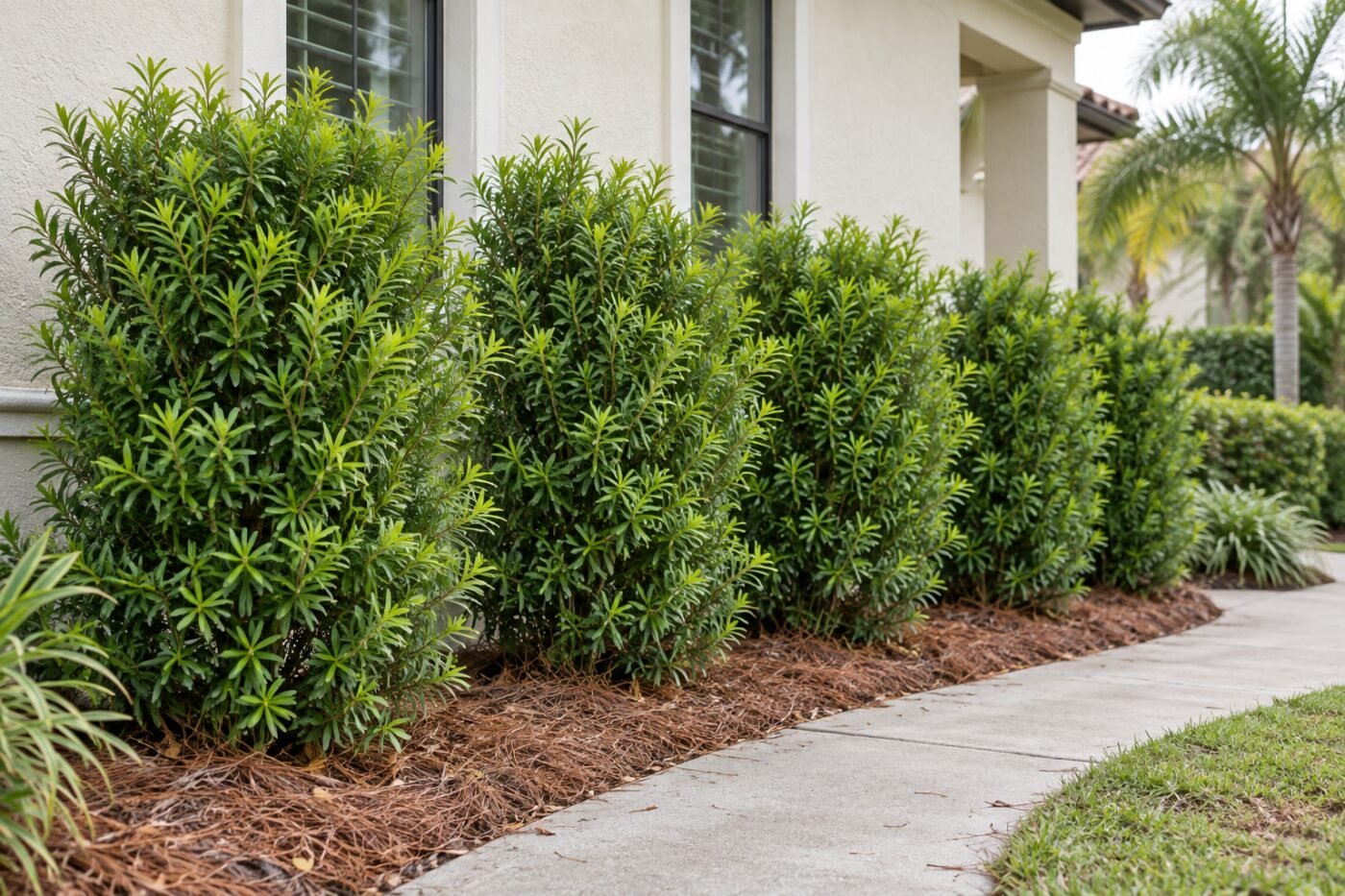
Getting podocarpus spacing right is the difference between a hedge that knits into a solid green wall and one that stays gappy for years. In this guide we give you clear spacing numbers for formal hedges, tall screens and double rows, a plant-count table for common fence lengths, and the care and pruning steps that keep a yew pine hedge full from the ground up.
Quick answer:
- Formal clipped hedge: 2 to 3 feet apart on center.
- Taller privacy screen: 3 to 4 feet apart.
- Loose screen or budget planting: 4 to 5 feet apart.
- Double staggered row: 3 to 4 feet apart in each row, rows about 3 feet apart.
- Growth rate: slow, so closer spacing pays off.
- Light: full sun to part shade.
Why Podocarpus Makes a Great Hedge
Podocarpus macrophyllus, often called yew pine or Buddhist pine, is an upright evergreen with dense, strap-like dark green leaves. It is not a true pine or a true yew. Instead, it belongs to an ancient conifer family that grows well across Florida and the Gulf Coast.
The UF/IFAS Extension fact sheet on Podocarpus macrophyllus calls it one of the few trees that can be pruned into a nice hedge. It also rates the plant highly tolerant of drought and salt spray, and it adapts to sand, clay, loam, acidic and alkaline soils as long as they drain well. As a result, it works in coastal yards where many hedge plants struggle.
Here in Jacksonville we also like it for its narrow shape. A podocarpus hedge stays slim, so it fits side yards and the strip between a driveway and a fence. In addition, it is deer resistant and needs far less trimming than fast growers like ligustrum.
Podocarpus Spacing for Every Hedge Style
Most guides give one number and move on. However, the right podocarpus spacing depends on the look you want, how tall you plan to keep it, and how patient you are. UF/IFAS Extension agents in Charlotte County suggest spacing hedge plants 2 to 4 feet apart and screens 4 feet or more. We use that range as a starting point.
| Hedge style | Target height | Spacing on center |
|---|---|---|
| Low formal hedge | 3 to 4 feet | 2 feet |
| Classic clipped hedge | 4 to 6 feet | 2.5 to 3 feet |
| Privacy screen | 6 to 10 feet | 3 to 4 feet |
| Informal tall screen | 10 feet and up | 4 to 5 feet |
“On center” means you measure from the middle of one plant to the middle of the next. So with 3-foot spacing, each trunk sits 3 feet from its neighbor.
Single row or double row?
A single row is enough for most yards. That said, a double staggered row gives faster, thicker privacy along a busy road. Set two rows about 3 feet apart, then offset the plants so each one sits between two plants in the other row. This zigzag pattern closes gaps sooner, but it nearly doubles your plant count.
How far from fences and walls?
Plant the row at least 2 to 3 feet out from a fence, wall or house. This gives you room to trim the back side and lets air move through the foliage. Also, keep in mind that UF/IFAS lists the untrimmed tree at 30 to 40 feet tall, so avoid spots under power lines unless you will keep it clipped.
How Many Podocarpus Plants Do You Need?
To turn your podocarpus spacing into a plant count, divide the hedge length in feet by the spacing, then add one for the end plant. For example, a 30-foot row at 3-foot spacing needs 11 plants. Here is a quick table for common lengths.
| Hedge length | 2 ft apart | 3 ft apart | 4 ft apart |
|---|---|---|---|
| 12 feet | 7 plants | 5 plants | 4 plants |
| 24 feet | 13 plants | 9 plants | 7 plants |
| 36 feet | 19 plants | 13 plants | 10 plants |
| 50 feet | 26 plants | 18 plants | 14 plants |
| 100 feet | 51 plants | 35 plants | 26 plants |
For a double staggered row, roughly double the number in the table. Because podocarpus grows slowly, we lean toward tighter podocarpus spacing when budget allows. Our multi-plant bundles lower the cost per plant, which helps a lot on long property lines.
How Fast Does It Grow?
UF/IFAS describes podocarpus as a slow grower, and that matches what we see in North Florida. It is not the plant for instant privacy, and slow growth is the main reason podocarpus spacing matters so much. Instead, it rewards patience with a hedge that stays dense and rarely gets away from you.
Growth speeds up with good conditions. Plants in full sun, in well-drained soil, with steady water during the first year put on the most new growth. Meanwhile, plants in heavy shade or soggy ground grow slowly and thin out.
From small starter plants, a realistic timeline looks like this:
- First year: roots spread out and plants settle in, with modest top growth.
- Second and third years: growth picks up, and light tip pruning makes plants branch.
- Later years: the row fills in and you can shear it into a solid hedge.
If you need a quicker screen, compare it with the faster options in our guide to fast-growing privacy hedge plants. Some homeowners even plant a faster hedge now and let podocarpus take over later.
Does Podocarpus Grow in Shade?
Yes, within limits. The NC State Extension Plant Toolbox lists it for full sun to partial shade, including dappled light under tall pines. Still, a hedge in deep shade gets thin and leggy at the base.
For the fullest hedge, aim for at least half a day of sun. Also, if one end of your row is shadier, use tighter podocarpus spacing on that end. Closer plants help make up for slower, sparser growth.
Planting Your Podocarpus Hedge
First, mark the row with string and stakes, then measure and flag each planting spot at your chosen spacing. Next, dig each hole as deep as the root ball and two to three times as wide. Set the plant so the top of the root ball sits level with the ground or slightly above it.
Podocarpus hates wet feet, so drainage matters as much as podocarpus spacing. If water stands in the area after rain, plant on a slight mound or choose another spot. After planting, water deeply and add 2 to 3 inches of mulch, keeping it a few inches back from the stems.
Water every two to three days for the first few weeks, then taper off as roots grow. Once established, podocarpus handles dry spells well. In addition, fall is a great time to plant in Florida, since cooler days mean less stress. See our guide to fall planting in Florida for timing tips.
Pruning a Podocarpus Hedge
Pruning shapes a young hedge more than anything else. Start early, while plants are small. Pinch or snip the tips after each flush of new growth, so each stem splits into two and the plant fills out from the bottom.
Once the hedge reaches the height you want, trim it a few times a year during the growing season. UF/IFAS notes that podocarpus responds better to hand pruning than to rough mechanical shearing, so sharp hand shears give a cleaner finish. Plants at even podocarpus spacing are also easier to shear into a uniform line. Then, in North Florida, finish heavy trimming by early fall so tender new growth can harden before frost.
Always shape the hedge so the base is a little wider than the top. This tapered shape lets sunlight reach the lower branches. As a result, the hedge stays green to the ground instead of going bare at the bottom.
Care, Pests and Honest Downsides
Podocarpus is low maintenance, but it is not problem-free. UF/IFAS says scale, mites and sooty mold sometimes show up, though usually not seriously. Podocarpus aphids can also curl new growth, and insecticidal soap used as the label directs controls them. On sandy soils, yellowing from magnesium deficiency can appear, and a fertilizer with magnesium corrects it.
Toxicity is the biggest concern for families. The seeds are poisonous if eaten, and NC State lists the plant as a problem for cats, dogs and horses. Only female plants make seeds, but you usually cannot tell the sex of a young plant. So if you have small children or pets that chew, keep an eye on the hedge once it matures, and pick up fallen seeds.
Proper podocarpus spacing also leaves room for air flow and makes pests easier to spot early. On the plus side, podocarpus is not on Florida’s invasive plant list, according to the UF/IFAS Charlotte County office. UF/IFAS also notes its roots rarely lift sidewalks.
Hardiness Zones and Climate
Our product page lists podocarpus as cold hardy in USDA zones 7 to 11. However, extension sources are more cautious. UF/IFAS rates it for zones 8B to 11, while NC State lists 7a to 9b. In colder zones, slower growth makes tight podocarpus spacing even more useful. If you garden in zone 7 or 8a, plant it in a sheltered spot, such as the south side of a building, and protect young plants during hard freezes.
What Arrives When You Order
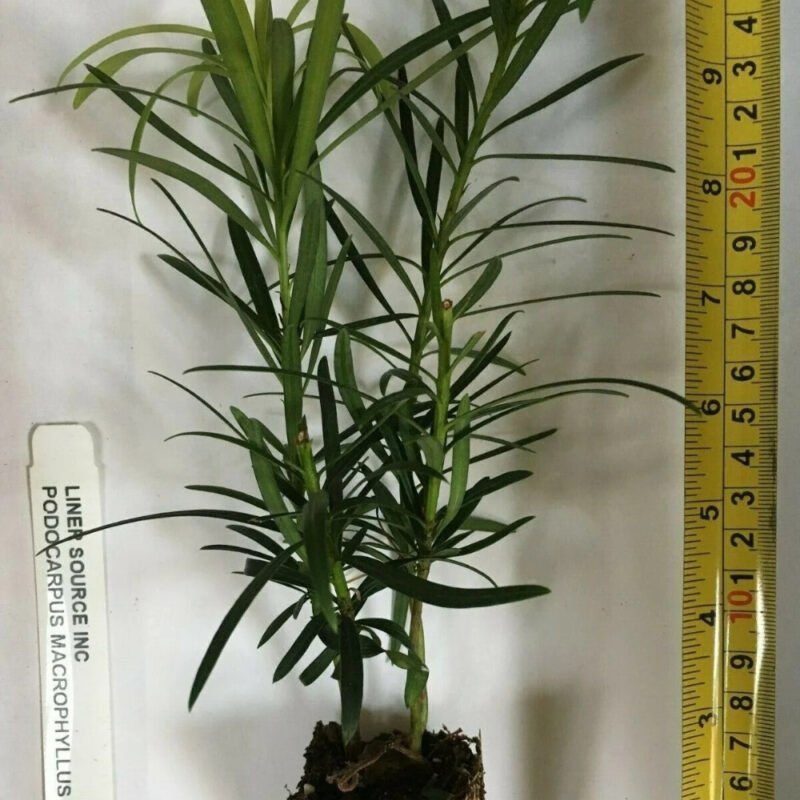
We ship our Podocarpus macrophyllus starter plants as live, rooted plants under 12 inches tall. Each one comes potted with its soil plug intact, not bare-root, and wrapped to hold moisture. These are young plants, so your hedge will take several seasons to reach privacy height, even with tight podocarpus spacing.
Small plants do have real advantages, though. They cost far less than large containers, which matters when your spacing plan calls for 20 or 30 plants. They also adapt quickly to your soil. For a deeper look at the trade-offs, read our take on buying starter plants online.
We offer free USPS First-Class shipping on most orders, and our 30-Day Happy Gardener Guarantee covers your plants. When your box arrives, follow our tips on what to do after your plants arrive. If you are still comparing options, our sweet viburnum hedge guide covers a faster, broadleaf alternative, and you can browse every option in our privacy hedge collection.
Podocarpus Spacing FAQ
How far apart should I plant podocarpus for a hedge?
For a formal clipped hedge, plant 2 to 3 feet apart on center. For a taller privacy screen, 3 to 4 feet works well. Go wider only if you can wait longer for the gaps to close.
How tall does a podocarpus hedge get?
Most homeowners keep it between 4 and 10 feet with regular trimming. Left untrimmed, it can grow into a tree 30 to 40 feet tall.
When should I trim podocarpus?
Trim during the spring and summer growing season, after each flush of new growth. In North Florida, wrap up heavy pruning by early fall.
Is podocarpus toxic to dogs?
Yes, the seeds are toxic to dogs, cats and horses if eaten. Only female plants produce them, so watch for seeds once the hedge matures and call your vet if a pet eats some.
Can podocarpus spacing be too close?
Yes. Plants spaced closer than about 2 feet compete for water and light, and the hedge gets harder to keep healthy. Stick to 2 feet as the minimum for a single row.
Start Your Podocarpus Hedge
With smart podocarpus spacing, steady early pruning and well-drained soil, you get a clean evergreen hedge that lasts for decades with little fuss. First, measure your fence line. Then use the table above to count your plants and choose a bundle size that fits. Order live podocarpus plants from our Jacksonville nursery, or call us at (904) 664-5227 with any questions.