
Red Tip Photinia Pros and Cons: Is It Still Worth Planting?

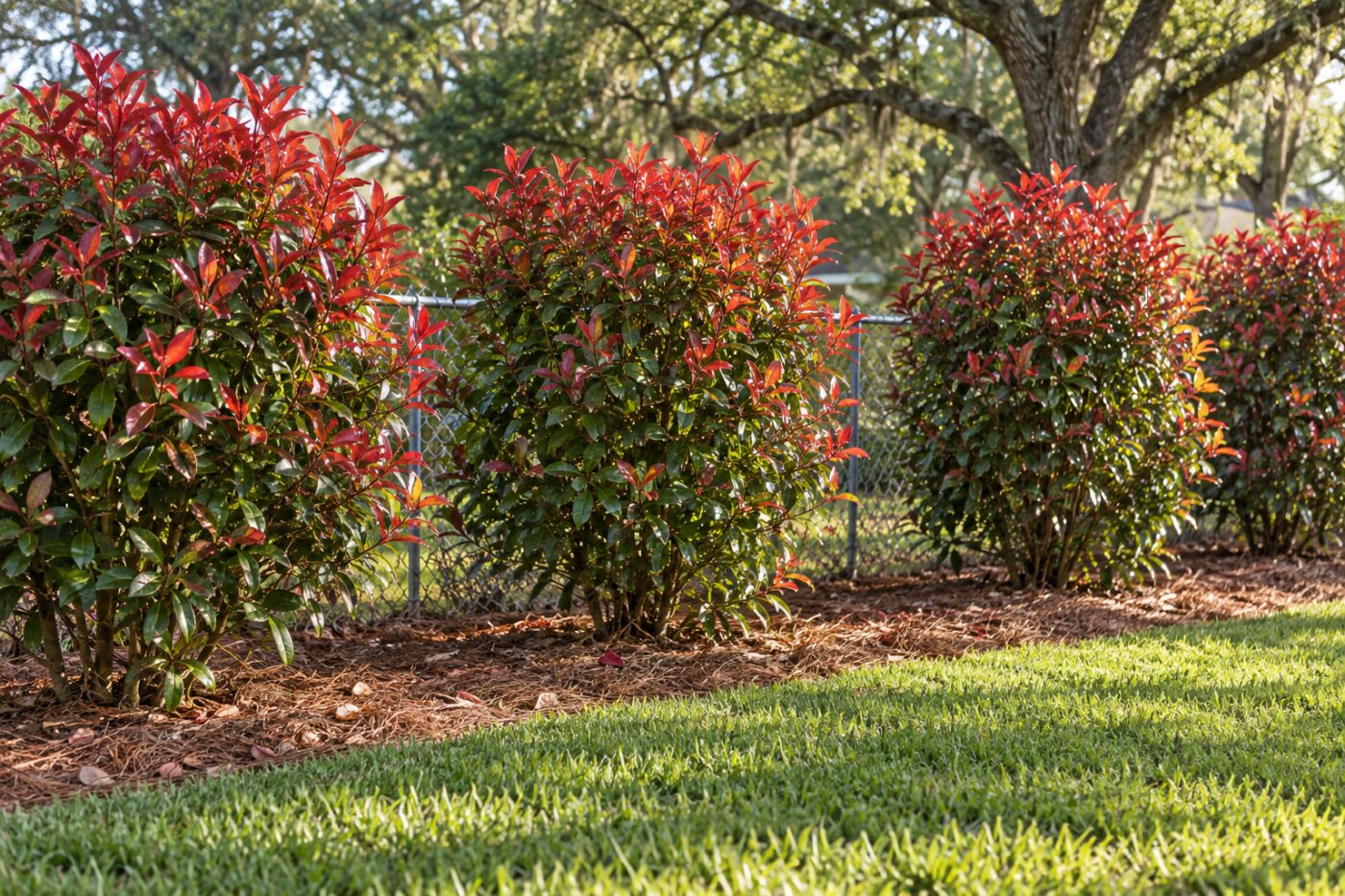
Red tip photinia was once the go-to hedge across the South, and then a leaf spot disease wiped out thousands of them. So what are the real photinia pros and cons today? In this guide we cover the good, the bad (mainly Entomosporium leaf spot), how spacing helps, the alternatives we grow and when photinia still makes sense.
Photinia Pros and Cons at a Glance
Here is the short version before we dig in. The facts below come from UF/IFAS, Clemson and NC State Extension.
| Pros | Cons |
|---|---|
| Bright red new growth in spring and after every trim | Highly susceptible to Entomosporium leaf spot |
| Fast, dense growth for screening | Gets big: 10 to 20 feet tall and 8 to 15 feet wide |
| High drought and salt-spray tolerance (UF/IFAS) | Also prone to fire blight and powdery mildew |
| Little invasive potential (UF/IFAS) | Needs full sun and good airflow, so it suffers in tight rows |
| Takes shearing well | Spring flowers have a scent many people dislike |
The Pros of Red Tip Photinia
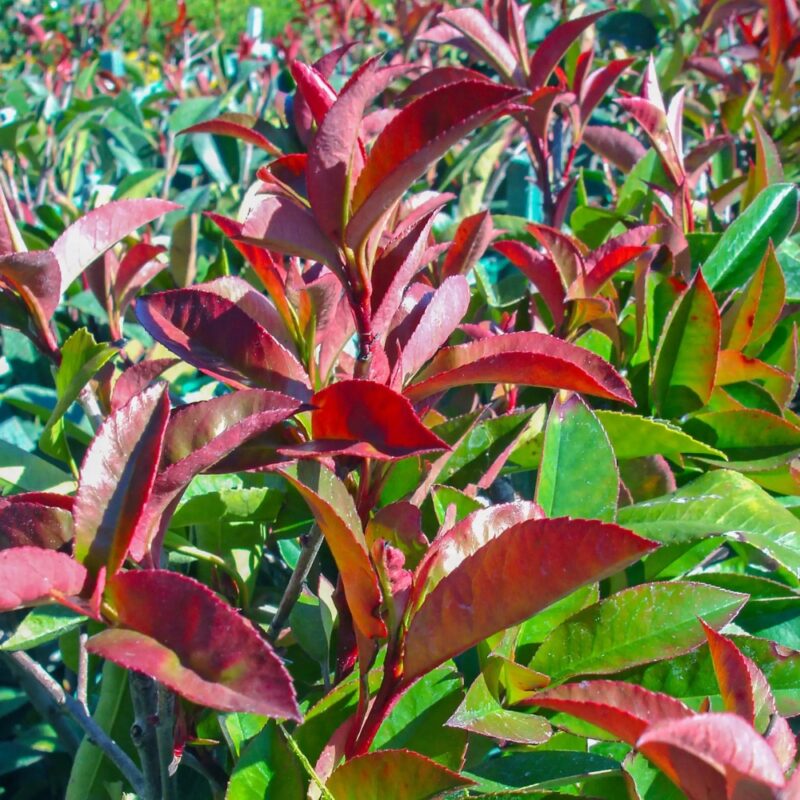
Few hedges put on a show like this one. Each spring, and again after every shearing, new leaves emerge glossy red and then mature to dark green. As a result, a well-kept row looks bright for much of the year.
It is also tough in many ways. According to the UF/IFAS fact sheet on Fraser photinia, the plant has high drought tolerance, high tolerance to salt spray and copes with urban heat, which is why it once filled parking lot islands. In addition, UF/IFAS rates it as having little invasive potential, unlike privets.
Growth is quick, too. The NC State Extension plant profile lists the growth rate as rapid, so young plants fill in faster than slow hedges such as podocarpus. Finally, photinia grows in sand, loam or clay as long as the soil drains well, and it handles alkaline soil better than many acid-loving shrubs.
The Cons: Entomosporium Leaf Spot and Other Red Tip Photinia Problems
Now for the hard part. The biggest drawback by far is a fungal disease called Entomosporium leaf spot. Clemson Extension puts it bluntly: red tip photinia is so susceptible that its use for hedging is not recommended. Similarly, UF/IFAS calls leaf spot diseases on this plant “very serious” and notes that there are better plants for hedges. That single issue outweighs most other photinia pros and cons in humid climates.
What the Leaf Spot Looks Like
The first signs are small, round, bright red spots on young leaves, on both the top and bottom surfaces. Over time, the spots grow and merge into maroon or purple blotches. Older spots then develop gray or tan centers with a dark red border, often with tiny black dots in the middle. Eventually, badly infected plants drop most of their leaves, and repeated defoliation can kill them.
Why It Spreads So Easily in Hedges
The fungus spreads by spores that splash in rain and irrigation water and drift short distances in the wind. Because of this, a tight row of identical shrubs gives it a perfect path from plant to plant. According to Clemson, it peaks in cool, rainy spring and fall weather, while Alabama Extension notes that symptoms appear 10 to 14 days after infection in warm, humid weather. Here in Jacksonville, that means our wet springs and humid falls both raise the risk.
Oklahoma State University Extension also reports that no red tip photinia selections are resistant. In other words, buying a different red tip will not fix it, which matters when you weigh the photinia pros and cons for a long hedge.
Other Drawbacks to Know
- Size: UF/IFAS lists 12 to 18 feet tall, and NC State says it can reach 20 feet with a 15-foot spread. Keeping it at 6 feet means regular pruning, a con many photinia pros and cons lists skip.
- Fire blight and mildew: both extension services list these as problems, especially in shade.
- Flower odor: NC State notes the white spring blooms smell offensive to many people.
- Pets: our product page lists the leaves as mildly toxic if eaten, so discourage dogs and livestock from chewing on clippings.
How to Reduce Leaf Spot: Spacing, Airflow and Care
You cannot make photinia immune; however, you can tilt the odds in your favor. Spacing, in particular, can change the photinia pros and cons for your yard. Most failures we hear about started with plants jammed together in shade and watered from above. Instead, follow these steps, which come from Clemson, Alabama and UF/IFAS guidance.
- Give it full sun. UF/IFAS warns that leaves often become infected when the plant grows in shade.
- Space plants wider than you think. We suggest 5 to 6 feet apart, center to center, for a hedge and 7 to 8 feet for a looser screen. Also keep the row at least 3 feet off a fence or wall so air can move behind it.
- Keep the leaves dry. Use drip or soaker hose at the base. If you must use sprinklers, run them early in the morning so foliage dries fast.
- Prune in winter. Clemson recommends pruning while the plant is dormant, because every trim pushes out tender new leaves, which are the ones the fungus attacks.
- Clean up. Rake and bag fallen spotted leaves, then add fresh mulch to cover what you miss.
- Plan for sprays if needed. Extension guides list fungicides such as chlorothalonil, propiconazole and myclobutanil, applied every 7 to 14 days from bud break until new leaves mature. Always follow the label.
For a deeper look at row layout, our hedge spacing chart and calculator shows how many plants you need for any length.
Photinia Spacing Chart
| Goal | Spacing | Plants per 50 feet |
|---|---|---|
| Sheared hedge, 6 to 8 feet tall | 5 to 6 ft | 9 to 11 |
| Informal screen, left taller | 7 to 8 ft | 7 to 8 |
| Single specimen or small tree | 10+ ft from other shrubs | 1 |
That said, even perfect spacing only lowers the risk. In a wet year, plan to watch the plants closely every spring and fall.
Alternatives If the Photinia Pros and Cons Worry You
If the disease risk puts you off, you have good options. Clemson suggests viburnums and loropetalum among its replacements, and we grow several hedge plants that rarely face this problem. Each one below ships as a starter from our nursery.
| Plant | Why choose it | Zones (product page) |
|---|---|---|
| Sweet Viburnum | Fast, tall, fragrant screen with red-tinged new growth | 8 to 10 |
| Ruby Loropetalum | Burgundy leaves all year and pink spring flowers | 7 to 10 |
| Podocarpus | Slow, neat, formal wall that tolerates salt | 7 to 11 |
| Wax Myrtle | Fast Florida native for sun or part shade | 7 to 11 |
| Needlepoint Holly | Dense, spiny barrier with winter berries | 7 to 9 |
| Viburnum Densa | Compact native hedge with spring flowers | 7 to 10 |
If you want red color specifically, Ruby Loropetalum is the closest swap, although it stays smaller. For pure height and speed, sweet viburnum is our usual pick; see our sweet viburnum hedge guide or compare it in sweet viburnum vs podocarpus. Meanwhile, our list of fast growing privacy hedge plants covers more choices.
When Photinia Still Makes Sense
Despite the warnings, we still grow and sell photinia, because it can work well in the right spot. It is a reasonable choice when:
- Your site gets full sun all day with open air around it.
- You plan to grow it as a single specimen, a small tree or a widely spaced screen rather than a tight wall.
- Your garden sits in zones 7 to 9, where it is hardy, especially in drier, cooler areas than coastal Florida.
- The red flush matters to you, and you will accept some leaf spot, cleanup and possibly sprays.
- Mixing it with other shrubs is an option, so one disease cannot run down the whole row.
On the other hand, skip it for a shady, crowded or sprinkler-soaked spot. In those places, the photinia pros and cons tilt firmly toward an alternative.
Is Photinia Worth Planting? Our Honest Verdict
Weighing all the photinia pros and cons, we see it as a good accent and a poor default hedge for humid Florida yards. Its color and toughness are real. Yet the disease risk is also real, so plan around it from day one. For a long, uniform privacy row in Jacksonville, we usually point people to sweet viburnum, wax myrtle or podocarpus first. For a sunny corner or a mixed screen, by contrast, a few photinia can add color that nothing else matches.
What Arrives When You Order
Our red tip photinia starter plants ship live and rooted, under 12 inches tall. We pot each one with its soil plug intact and wrap it to hold moisture, so it is not bare-root. Therefore, expect a young plant that grows into the sizes above, not an instant hedge. Our post on whether starter plants are worth it explains why young shrubs often establish well.
We sell single plants and multi-plant bundles, which lower the cost per plant for a hedge or a mixed screen. Most orders ship free by USPS First-Class, and our 30-Day Happy Gardener Guarantee applies. Just contact us within 48 hours with photos if a plant arrives damaged. Once it arrives, follow our after-arrival care guide.
Photinia Pros and Cons FAQ
Why Are Red Tip Photinias Dying?
Most often, the cause is Entomosporium leaf spot. Repeated leaf loss weakens the plant until it dies. Fire blight can also kill branches or whole plants quickly.
Can Red Tip Photinia Recover From Leaf Spot?
Mild cases often recover if you clean up fallen leaves, stop wetting the foliage, prune only in winter and protect new growth with fungicide. However, plants that have lost most of their leaves for several seasons rarely bounce back.
How Far Apart Should I Plant Red Tip Photinia?
We suggest 5 to 6 feet apart for a hedge and 7 feet or more for a screen. Wider spacing improves airflow, which helps leaves dry and slows the spread of leaf spot.
Does Photinia Grow Well in Florida?
It is hardy in North and Central Florida, roughly zones 8 and 9. Still, our humid climate favors leaf spot, so full sun, wide spacing and drip watering matter more here.
What Is a Good Replacement for Red Tip Photinia?
For a tall screen, try sweet viburnum or wax myrtle. For red foliage, Ruby Loropetalum is a strong substitute, and podocarpus suits a neat formal hedge.
The Bottom Line
The photinia pros and cons come down to this: spectacular color and toughness, balanced against serious leaf spot risk in humid weather. If you have full sun and room for wide spacing, it can still earn its place, so browse our Photinia Red Tip plants. Otherwise, explore our privacy hedge collection for disease-resistant options. Questions? Call us at (904) 664-5227 or email [email protected].