
How Many Shrubs for a Hedge? Spacing Chart and Calculator

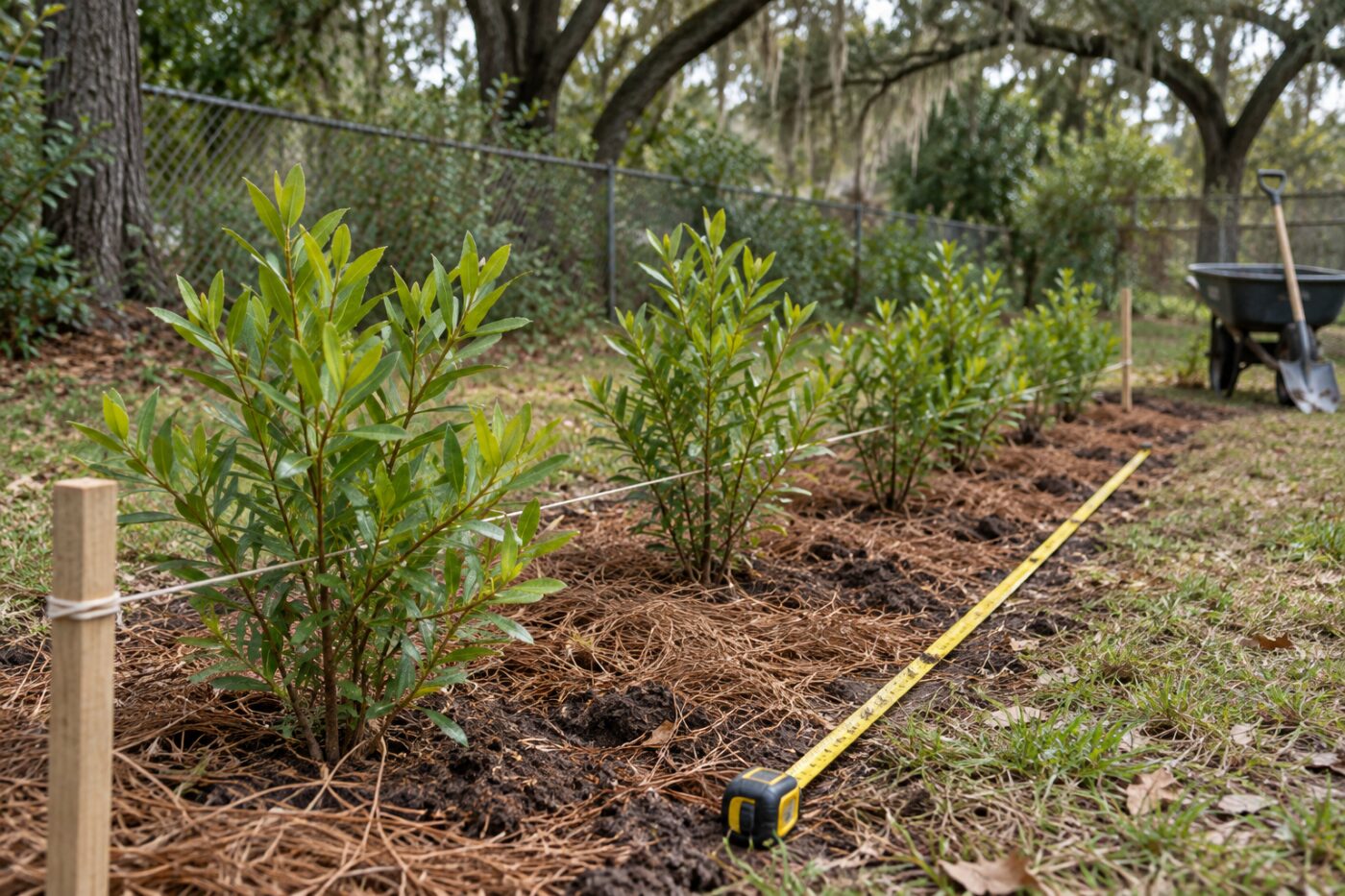
How many shrubs for a hedge you need comes down to two numbers: the length of the row and the spacing that suits the plant you pick. In this guide we give you a simple formula, a spacing chart for six common hedge shrubs and a ready-made plant count table, so you can order the right number the first time.
Quick answer:
- Formula: divide the hedge length by the spacing, round up, then add one plant for the end of the row.
- Typical spacing: 2 to 3 feet for a low clipped hedge, 3 to 4 feet for a privacy hedge, 4 to 6 feet for a loose screen.
- Example: a 50-foot row at 3 feet apart takes 18 plants.
- Double staggered row: plan on roughly twice as many plants.
- Buffer: add one or two spares for corners and replacements.
The Formula: How Many Shrubs for a Hedge
First, measure the full length of the planting line in feet. Then divide that number by the spacing between plants, measured center to center. If the result is not a whole number, round up. Finally, add one, because a row with a plant at both ends always has one more plant than gaps.
Plants = (hedge length ÷ spacing, rounded up) + 1
For example, a 40-foot fence line at 4 feet apart gives 10 gaps, so you need 11 shrubs. At 3 feet apart, 40 divided by 3 is 13.3, which rounds up to 14 gaps, so you need 15 shrubs. Rounding up keeps the spacing slightly tighter than planned, and that is the safe direction for a hedge.
Some designers also start the first plant half a space in from each end instead of right at the corner. In that case, skip the extra plant and use length ÷ spacing. Either way, the count only changes by one, so pick the layout that fits your yard.
What Spacing Should You Use?
Before you settle on how many shrubs for a hedge to buy, choose the spacing, because that is where most people go wrong. Planting too far apart leaves gaps for years, while planting too close forces the shrubs to compete for light, water and air. A good rule of thumb is to space a hedge at about half the width the plant reaches when it is trimmed to your target size.
UF/IFAS Extension agents in Charlotte County offer a useful benchmark: 2 to 4 feet apart for a formal hedge and 4 feet or more for a screen. They also suggest thinking about mature size and how quickly you want the plants to grow together before you dig.
So, closer spacing gets you privacy sooner but costs more plants. Wider spacing saves money, although the hedge takes longer to close. Fast growers like wax myrtle can go wider, whereas slow growers like podocarpus usually go closer.
Hedge Spacing Chart by Plant
Here is the spacing we suggest for six popular hedge shrubs, based on extension guidance and each plant’s mature size. Use the lower number when you want a dense hedge quickly, and the higher number when budget matters more than speed. Then plug that spacing into the formula to see how many shrubs for a hedge of your length.
| Plant | Spacing on center | Hedge height | Growth | USDA zones |
|---|---|---|---|---|
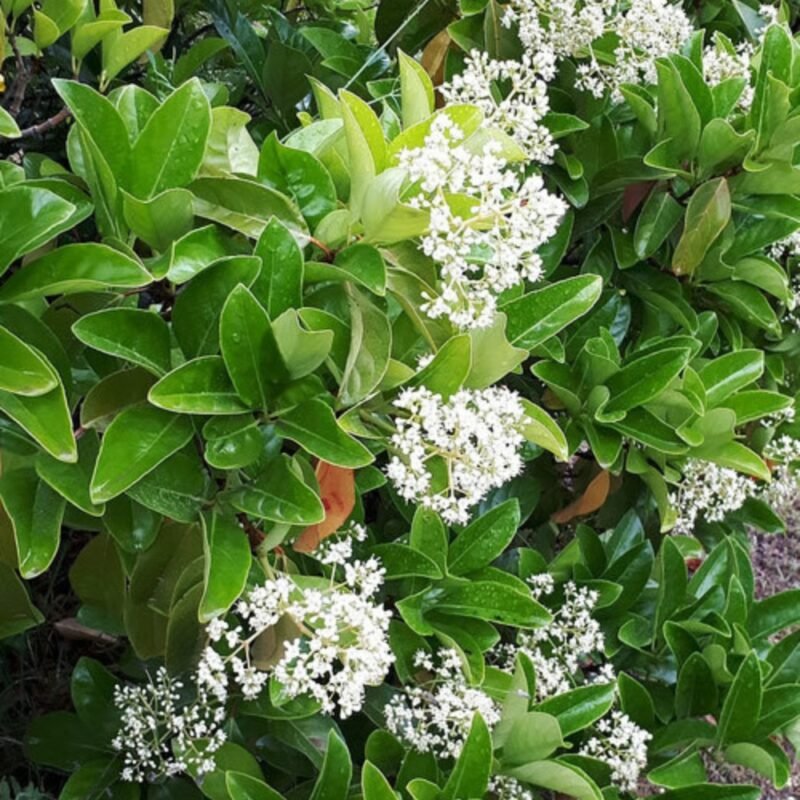
| Sweet viburnum | 3 to 4 ft | 4 to 8 ft or taller | Fast | 8 to 10 |
| Podocarpus | 2 to 3 ft (screen 3 to 4) | 3 to 10 ft | Slow | 7 to 11 |
| Japanese boxwood | 18 to 24 in | 2 to 4 ft | Slow | 6 to 9 |
| Wax myrtle | 4 to 6 ft | 8 to 15 ft | Very fast | 7 to 11 |
| Italian cypress | About 3 ft | Tall, narrow screen | Moderate | 7 to 10 |
| Little Giant arborvitae | 2 to 3 ft | 2 to 4 ft | Slow | 3 to 8 |
Want the details for one plant? Our sweet viburnum spacing guide and podocarpus hedge guide go deeper on pruning and growth rate.
How Many Shrubs for a Hedge: Quick Count Table
If you would rather skip the math, use this table as a quick calculator. It shows how many shrubs for a hedge in a single straight row, with a plant at each end.
| Hedge length | 2 ft apart | 3 ft apart | 4 ft apart | 5 ft apart |
|---|---|---|---|---|
| 25 feet | 14 | 10 | 8 | 6 |
| 50 feet | 26 | 18 | 14 | 11 |
| 75 feet | 39 | 26 | 20 | 16 |
| 100 feet | 51 | 35 | 26 | 21 |
For lengths in between, run the formula or add the closest rows together. For instance, a 125-foot line at 4 feet is roughly the 100-foot count plus the 25-foot count, minus one shared plant: 26 + 8 – 1 = 33.
Single Row vs Double Staggered Row
A single row works for most yards. It is simple to plant, easy to water and easy to trim from both sides. However, a double staggered row builds a thicker, faster screen, especially along a busy road or a long open property line.
To plant a staggered row, set two parallel lines about 2 to 3 feet apart. Then space plants normally within each row, but shift the second row so each plant sits opposite a gap in the first. The result is a zigzag that closes in sooner.
Counting plants for a double row
A second row roughly doubles how many shrubs for a hedge you need. Next, run the formula for each row separately. Because the second row is offset by half a space, it usually takes one fewer plant than the first. So a 50-foot double row at 4 feet apart needs 14 plants in the front row and 13 in the back, or 27 shrubs in total.
Keep in mind that a double row needs more width. Plan on a bed at least 5 to 6 feet deep, plus room to trim the back side. That said, for tall screens such as wax myrtle or sweet viburnum, the extra density can be worth it.
Corners, Curves and Fence Lines
Corners also change how many shrubs for a hedge you need. An L-shaped or U-shaped layout takes a small adjustment. Measure each straight run, count each one with the formula, then subtract one plant for every corner, since two runs share that corner plant. For a curve, lay a garden hose along the planting line, then measure the hose.
Also leave room behind the hedge. Plant the row at least 3 feet out from a fence, wall or house so you can reach the back to trim, and so air can move around the leaves. Wide shrubs like sweet viburnum appreciate even more space.
Finally, add one or two extra plants to your order. A spare kept in a pot is handy if a plant fails in the first year, and it will be the same age and size as the rest of the hedge.
Which Shrubs Make the Best Hedge for Your Yard?
Choosing the plant matters as much as counting it, because each one changes the spacing and the final look. Here is how the six shrubs compare.
- Sweet viburnum: fast, dense and leafy, a top Florida pick for 6- to 10-foot privacy. Compare it side by side in our sweet viburnum and podocarpus comparison.
- Podocarpus: slow but tidy, salt tolerant and easy to keep narrow. Its seeds are poisonous if eaten, so keep that in mind around kids and pets.
- Wax myrtle: a very fast, salt-tolerant Florida native. It can sucker at the base, and extension sources rate it as flammable, so keep it away from the house in fire-prone areas.
- Japanese boxwood: ideal for a low, formal edge. That said, UF/IFAS lists boxwood among landscape plants often damaged by root-knot nematodes in Florida, so it does best in richer soil in zone 9 and north.
- Italian cypress: a vertical screen rather than a clipped hedge. UF/IFAS notes that trees planted 3 feet apart make a dense screen, but it also warns that mites are common and that this tree should not be pruned.
- Little Giant arborvitae: a neat globe for low hedges in zones 3 to 8. Since most of Florida is zone 9 or warmer, we suggest it for gardens farther north.
For more fast options, see our list of fast privacy hedge picks for Florida. If you want a low, native edge in front of a hedge, our coontie care guide and roundup of ground covers for sun and sand cover good companions.
Buying Tips: What Arrives When You Order
We ship live, rooted starter plants under 12 inches tall. Each one comes potted with its root plug of soil intact, not bare-root, and wrapped to hold moisture. They are young plants, so they grow into the hedge sizes in our chart over the next few seasons rather than on day one.
That size is also why bundles help. Most of our hedge shrubs come as single plants or multi-plant bundles, and a bundle lowers the cost per plant. Once you know how many shrubs for a hedge your row needs, pick the bundle that covers that count plus a spare or two.
In addition, starter plants are easier to plant, settle in quickly and cost far less to ship. Read why small starter plants are worth it for the full picture, and follow our care steps for the first week once your box arrives.
Shipping is free on most orders within the continental United States. Orders go out in 2 to 5 business days, and we may hold a shipment during a hard freeze or extreme heat to protect the plants. Fall is a great time to plant here, so see our fall planting tips if you are planning ahead.
Hedge Spacing FAQ
How many shrubs for a hedge that is 100 feet long?
At 3 feet apart you need 35 shrubs, at 4 feet you need 26, and at 5 feet you need 21. For a double staggered row, roughly double those numbers.
How far apart should hedge plants be?
Most hedges work at 2 to 4 feet on center. Low clipped hedges sit closer, while tall, loose screens can go 4 to 6 feet apart.
Is it better to plant a hedge too close or too far apart?
Slightly close is usually better than too far, because gaps take years to fill. Still, avoid crowding below the low end of the range, or the plants will compete and thin out.
How long does a new hedge take to fill in?
It depends on the plant. Fast growers like wax myrtle and sweet viburnum close in much sooner than slow growers like podocarpus and boxwood, especially with regular water in the first year.
Should a hedge be one row or two?
One row suits most yards. Choose a double staggered row when you need a thick screen quickly and have a bed at least 5 to 6 feet deep.
Plan Your Hedge Today
Now you have everything you need: measure the line, pick a spacing from the chart, then run the formula or use the count table. Add a spare or two, and you will know exactly how many shrubs for a hedge to order. When you are ready, browse our privacy hedge plants or the full shrubs and bushes collection, and choose the bundle size that matches your count.