
Columnar Evergreen Trees for Narrow Spaces and Privacy

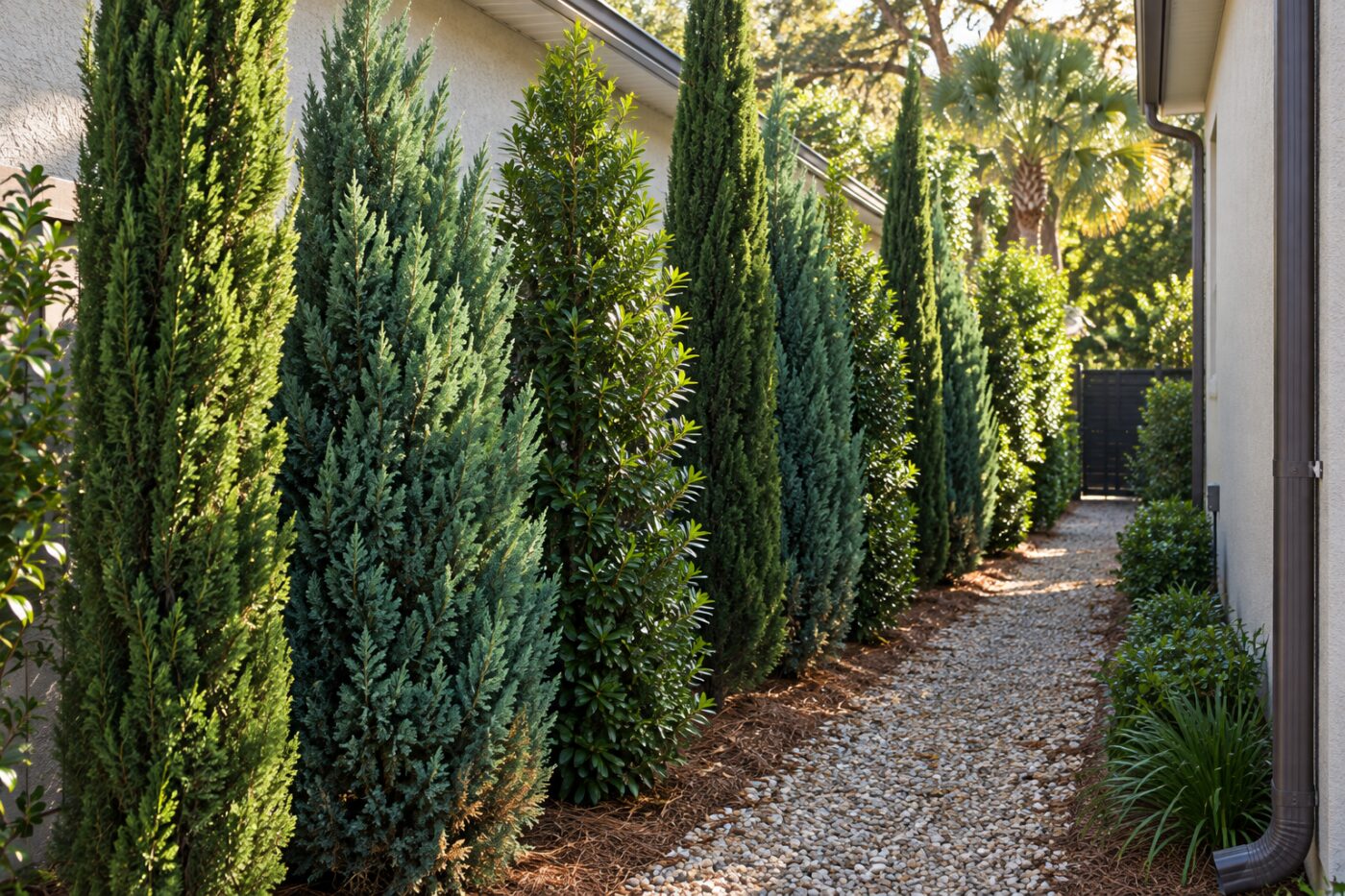
Columnar evergreen trees solve a common problem: you need height and year-round green, but you only have a few feet of ground. This buying guide compares the four slim evergreens we grow side by side, so you can match width, height, speed and Florida toughness to your actual space.
Columnar Evergreen Trees at a Glance
If you only read one section, read this one:
- Slimmest: Skyrocket juniper, about 2 to 3 feet wide, but it struggles in humid Southern summers.
- Tallest: Italian cypress, often 25 to 40 feet tall in the East, yet only 3 to 6 feet wide.
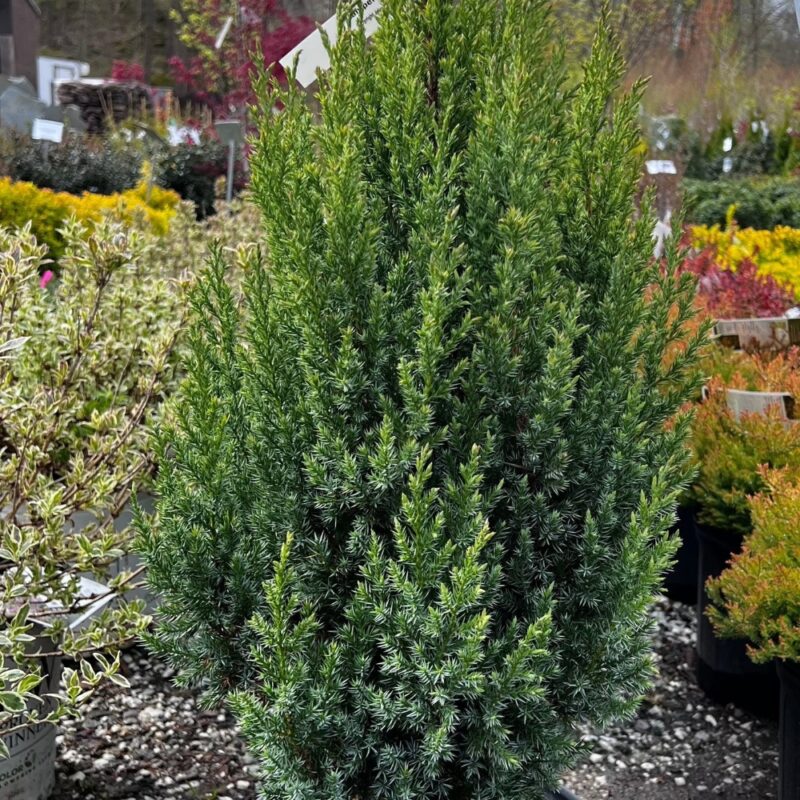
- Toughest juniper: Spiny Greek juniper, wider at 4 to 5 feet, with prickly foliage that also deters foot traffic.
- Best for most Florida yards: podocarpus, because it handles heat, humidity, salt and part shade, although it needs shearing to stay narrow.
Side-by-Side Comparison of Our Columnar Evergreen Trees
Here is how the four compare. Specifically, sizes come from UF/IFAS, NC State Extension and our product pages. When sources disagree, we show the more conservative number first.
| Feature | Italian Cypress | Skyrocket Juniper | Spiny Greek Juniper | Podocarpus |
|---|---|---|---|---|
| Mature width | 3 to 6 ft | 2 to 3 ft | 4 to 5 ft | 3 to 4 ft if sheared (much wider unpruned) |
| Mature height | 25 to 40 ft (UF), up to 70 ft elsewhere | 15 to 20 ft | 12 to 15 ft | Usually kept at 6 to 15 ft by shearing |
| Growth rate | Moderate, faster when young | Slow (UF) | Moderate, about 6 to 12 in a year | Slow |
| USDA zones | 7 to 10 | 4 to 9 | 4 to 9 | 8b to 11 (UF); 7 to 11 (our page) |
| Humidity and disease | Fair, although spider mites and root rot in wet soil are common | Poor, especially in humid weather (tip blights, rusts) | Fair if it gets sun and airflow, but rust can appear | Good; the most humidity-proof of these columnar evergreens |
| Salt spray | Moderate | Unknown (UF) | Moderate (Chinese juniper) | High |
| Sun | Full sun | Needs full sun | Full sun only | Sun to part shade |
| Best use | Tall formal accents, driveway rows | Tight accents, but only in drier, cooler zones | Barrier screen, windbreak | Sheared column or narrow hedge |
As you can see, no single plant wins every row. Instead, the right pick depends on your width limit, your height goal and how humid your summers get.
The Four Narrow Evergreen Trees We Grow
In practice, each of these columnar evergreen trees fills a different role. We cover care in depth elsewhere, so this section focuses on what sets each one apart.
Italian Cypress: The Tallest and Most Formal
For a classic look, nothing says Mediterranean like a row of Italian cypress. According to the UF/IFAS fact sheet on ‘Glauca’ Italian cypress, it grows 25 to 40 feet tall but only 3 to 6 feet wide, with high drought tolerance and moderate salt tolerance. UF/IFAS also rates its invasive potential as low.
That said, UF/IFAS warns that it quickly outgrows most home landscapes and can look like “a green telephone pole.” For spacing, drainage and spider mite control, see our Italian cypress spacing and care guide.
Skyrocket Juniper: The Slimmest Column
Skyrocket juniper (Juniperus scopulorum ‘Skyrocket’) is the pencil of the group, with silvery blue-green foliage and a width of just 2 to 3 feet. However, the UF/IFAS Rocky Mountain juniper fact sheet says the species is difficult to grow in the South because of disease. UF also lists growth as slow and notes that older plants can bend open once they pass about 15 feet. So we see it as a choice for drier, airy spots, especially in zones 7 and 8. Also, our Skyrocket juniper care guide explains how to give it the best odds.
Spiny Greek Juniper: A Wider, Tougher Juniper
Spiny Greek juniper is an upright Chinese juniper with dense, sharply prickly blue-green needles. For example, the American Conifer Society describes it as broadly columnar to conical, growing roughly 6 to 12 inches a year. Because it grows 4 to 5 feet wide, it reads more like a thick column than a pencil.
In addition, the spiny foliage makes it a good barrier along a property line or under a window. On the other hand, it is unpleasant to brush past, so keep it away from narrow paths. Finally, like all junipers, it wants full sun, sharp drainage and moving air.
Podocarpus: The Shade-Tolerant Florida Workhorse
Technically, podocarpus is not a natural column. Left alone, the UF/IFAS podocarpus fact sheet lists it at 30 to 40 feet tall and 20 to 25 feet wide. Yet it takes shearing so well that Southern gardeners have kept it as a tall, narrow column for generations.
It also has the strongest Florida résumé here: high salt and drought tolerance, full sun to part shade, and no major pest or disease problems according to UF/IFAS. For hedge details, also read our podocarpus spacing guide.
How to Choose Columnar Evergreen Trees for Your Yard
Start with the space, then narrow the list by climate and purpose. These three questions usually settle it.
Measure Your Space First
First, measure the planting strip at ground level and at roof height. Next, subtract room for air between the plant and any wall, fence or driveway, usually 2 to 4 feet. If you have less than 3 feet of usable width, Skyrocket or a tightly sheared podocarpus is the realistic option. With 4 to 6 feet, however, Italian cypress and Spiny Greek juniper both fit.
Match the Plant to Your Climate
In general, humidity matters more than cold for these plants. In North Florida and the Gulf Coast, podocarpus is the safest bet, while Italian cypress does well on sandy, well-drained sites. Junipers, by contrast, prefer drier air, so they perform best in zones 7 and 8 inland or in raised, breezy spots. Near the coast, choose podocarpus first because of its high salt tolerance.
Decide Between Privacy and Accent
For a continuous privacy screen, you want plants that fill in sideways, such as podocarpus or Spiny Greek juniper. For vertical accents that frame an entry or a view, choose the slim columnar evergreen trees: Italian cypress or Skyrocket. Mixing two types also works well, and it spreads your risk if one plant has a bad year.
Honest Florida Caveats for Columnar Evergreens
Most top lists of columnar evergreen trees come from cooler, drier regions. As a result, they recommend arborvitae, spruce and Rocky Mountain junipers that often decline in our heat and humidity. Here is what we tell Jacksonville customers:
- Skyrocket juniper: UF/IFAS calls the species difficult in the South due to disease. Plant it only where foliage dries fast and soil drains well.
- Italian cypress: spider mites are common, and root rot follows poorly drained soil. UF/IFAS also notes canker disease has killed many trees in California.
- Spiny Greek juniper: there is little Florida research on this cultivar, so treat it like any juniper: full sun, sharp drainage and no overhead irrigation.
- Podocarpus: the most reliable here, but it grows slowly. Also, the ASPCA lists it as toxic to dogs, cats and horses, and UF/IFAS warns against eating its fruit-like seeds.
For the cypress and junipers, keep pets from chewing foliage and berries as a general precaution. As for invasiveness, UF/IFAS rates Italian cypress as low risk and podocarpus as not a problem species, while Rocky Mountain juniper has not been assessed.
Spacing Columnar Evergreen Trees for Privacy
Spacing depends on whether you want a solid wall or separate columns. Measure center to center, then use our hedge spacing chart and calculator to count plants.
| Plant | Solid screen | Separate accents | Plants for a 20-ft screen |
|---|---|---|---|
| Italian cypress | 3 to 4 ft | 6 to 10 ft | About 5 to 7 |
| Skyrocket juniper | 2 to 3 ft | 4 to 5 ft | About 7 to 10 |
| Spiny Greek juniper | 3 to 4 ft | 6 to 8 ft | About 5 to 7 |
| Podocarpus | 2 to 4 ft | 5 to 6 ft | About 5 to 10 |
In humid climates, then, err toward the wider number. Extra air between plants helps foliage dry, which matters for the junipers especially.
What Arrives When You Order
We ship every plant in this guide as a live, rooted starter under 12 inches tall. Each one comes potted with its soil plug intact, not bare-root, and wrapped to hold moisture. Therefore, plan for a young plant that grows into these columns over several seasons, not an instant screen. Our post on whether starter plants are worth it explains why small plants often root in faster.
We sell single plants and multi-plant bundles, so bundles lower the cost per plant for a row. Most orders ship free by USPS First-Class, and our 30-Day Happy Gardener Guarantee applies. Just contact us within 48 hours with photos if a plant arrives damaged. When your box lands, follow our after-arrival care steps. Fall is also a good time to plant in Florida, as our fall planting guide explains.
Columnar Evergreen Trees FAQ
What Is the Skinniest Evergreen Tree for Privacy?
Skyrocket juniper is the slimmest of our columnar evergreen trees at 2 to 3 feet wide. However, in humid Florida a sheared podocarpus kept 3 feet wide is usually more dependable.
Which Columnar Evergreen Grows Best in Florida?
Podocarpus, because it tolerates heat, humidity, salt and part shade. Italian cypress is a good second choice in full sun and sandy, well-drained soil.
How Close to a House Can I Plant a Columnar Tree?
Plant at least 2 to 4 feet from walls, fences and eaves, measured from the trunk. That way, the gap gives room for airflow, pruning and a ladder.
How Fast Do Narrow Evergreens Grow?
Italian cypress grows fastest when young. Spiny Greek juniper adds roughly 6 to 12 inches a year, while UF/IFAS rates Skyrocket juniper and podocarpus as slow.
Do Columnar Evergreens Need Pruning?
Generally, Italian cypress and the junipers need little beyond removing dead or wayward shoots. Podocarpus, in contrast, needs regular shearing if you want it to stay narrow.
Picking Your Columns
The best columnar evergreen trees for you are the ones that fit both your space and your summer. In short, for most Florida yards, start with podocarpus, add Italian cypress for height, and save Skyrocket for drier, airy spots. Ready to plan your row? Browse our privacy hedge plants or compare more options in our fast growing privacy hedge guide. Questions? Call us at (904) 664-5227 or email [email protected].